Dermal fillers
in Whitley Bay.
Dermal fillers (lips, cheeks, chin, jawline, nasolabial) is a consultation led treatment tailored to your goals, medical history and suitability. It is available at Refined Medical Aesthetics, our nurse led clinic on Double Row, Seaton Delaval, near Whitley Bay, NE25 0PP. Pricing, suitability and a careful, personalised plan are discussed before treatment.
Nurse led clinic. Careful, documented treatment.
Balanced hyaluronic filler. Lips. Cheeks. Lower face. Restores structure. Never overfilled.

What to expect.
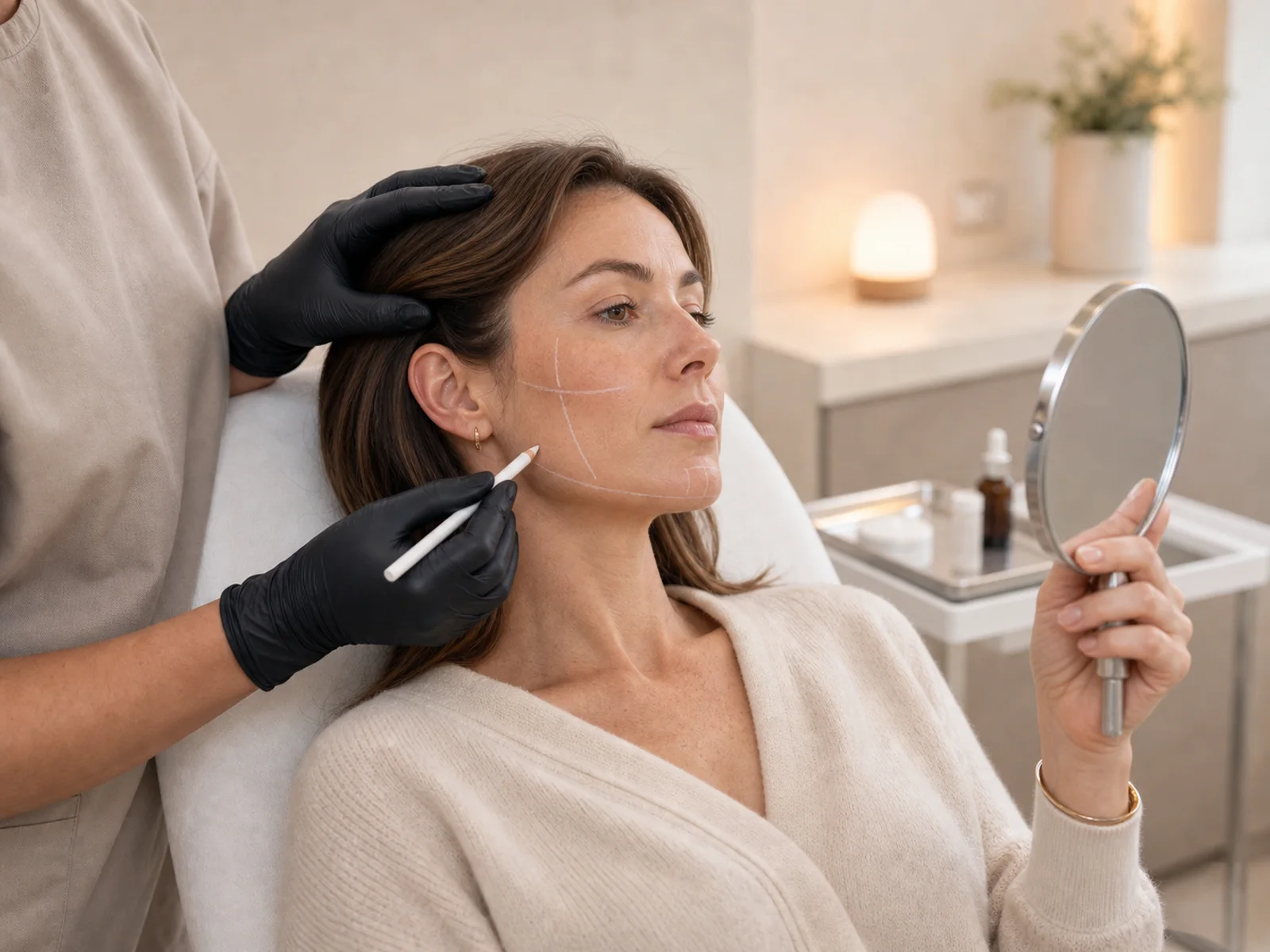
Hyaluronic-acid filler placed conservatively. Restores volume and profile balance. My approach is built on restraint. Start small. Review in two weeks. Add only if needed. Every filler at Refined is reversible.
Areas we treat: Lips · Cheeks · Jawline & profile
Three steps.
What it costs.
Filler is priced by area and volume. The fees below are starting prices. Some clients need a touch more. Some less. We agree everything at consultation before any needle goes near you.
| Area | Price | |
|---|---|---|
| Profile contouring (full facial balancing)Full facial balancing plan across profile and proportions. | £600 | |
| Lip filler. 0.5mlNatural starting point for shape, hydration and symmetry. | £150 | |
| Lip filler. 1mlMore shaping and volume while keeping the result balanced. | £190 | |
| Nasolabial folds (smile lines)Softens smile lines with supportive filler. | From £190 | |
| Piriform fossa fillerSupports the area beside the base of the nose and may soften the upper smile line. | £180 | |
| Marionette lines (corners of mouth)Supports the mouth corners and lower-face folds. | From £190 | |
| Cheeks (mid-face support, lift)Adds subtle mid-face support and lift. | From £220 | |
| Chin (projection, balance)Balances the side profile and lower face. | From £220 | |
| Jawline (definition)Adds definition and structure along the lower face. | From £220 |
Two-week review on every treatment. Free consultation if you’re new. I use it to map your face. We agree exactly what you need. Which is often less than you expect.
What it actually is.
Dermal filler is hyaluronic acid. The same molecule your body already makes in your skin, joints and eyes. I inject a small amount into specific layers of your face. It adds structure, restores lost volume, or balances asymmetry.
Hyaluronic acid is the only filler I’ll use. It’s reversible. If you don’t like the result, or if I need to adjust it, I can dissolve it with hyaluronidase. That safety net is non-negotiable. I won’t practise without it.
Different products for different jobs. Soft, hydrating fillers for delicate areas like the lip border. Firmer, lifting fillers for cheekbones and jawline. The right product. The right plane. The right volume. That’s the difference between a result that’s undetectable and one that screams “done”.
Filler done well restores. It doesn’t reshape. The face I work on at 35 should look like the same face at 25. Not a younger version. Just a better-supported one. Cheek filler shouldn’t make you look fuller. It should make you look rested. Jawline filler shouldn’t add bulk. It should make your jaw look intentional. The brief is always “you, just refined”.
Where I treat.
Lips. Subtle hydration, defined border, gentle volume. Most first-timers need 0.5ml. More on the lip filler page.
Cheeks. Structural support for the mid-face. Done well, this lifts the lower face without adding fullness. The before-and-after looks like you slept properly. More on the cheek filler page.
Chin. Chin filler corrects projection, balances a recessive jawline, and helps the side profile sit the way you want it to.
Jawline. Jawline definition for clients who’ve lost angularity over time, or who want a more intentional jaw without surgery. Subtle. You’re aiming for a clean line, not a chiselled one.
Nasolabial folds. The lines that run from the nose to the corner of the mouth. Often these are addressed by treating the cheek instead, which lifts the fold from above. Sometimes a tiny bit of filler in the fold itself.
Marionette lines. The lines from the corner of the mouth to the chin may be assessed for filler where suitable.
Who this is for.
Filler suits clients who want subtle restoration or balance. Not a different face. You’re a good candidate if you’re 18+, in good general health, not pregnant or breastfeeding, and happy to come for a free consultation first.
I’ll ask you to wait, or send you elsewhere, if you have an active skin infection, an autoimmune flare, recent dental work in the area, a cold sore (if treating around the mouth), or a big event in the next 2 weeks. Results take that long to settle.
If you’ve got body dysmorphia, or you’re comparing yourself to a heavily-edited photo, sometimes the answer is “not yet”. I’ll tell you that honestly.
From door to done.
Numbing cream goes on first. We leave it 15 minutes. Most filler products also contain a small amount of local anaesthetic mixed in.
I work area-by-area, often using a cannula (a blunt-tipped needle) for cheek and jawline to reduce bruising and stay safer around blood vessels. Lips are typically done with a sharp needle in small precise points.
You’ll see immediate result. But expect some swelling for 24-48 hours. The real picture is at 14 days, when the product has fully integrated and any swelling has settled.
The first 48 hours.
- Ice on and off for the first few hours
- No alcohol for 24 hours (alcohol thins blood, makes bruising worse)
- No strenuous exercise for 24 hours
- No saunas, steam rooms, sunbeds for 48 hours
- No facials, microneedling, peels or other facial treatments for 14 days
- Sleep on your back the first night if possible
- Drink plenty of water. HA attracts water, hydration helps the result settle
- Bruising can happen after filler. Follow the written aftercare and contact the clinic if you are concerned.
Anything feels wrong? Severe pain. White patches. Vision changes. Anything that feels worse than a normal recovery. WhatsApp me immediately. Vascular occlusion is rare. But it’s the one thing where speed matters.
What I tell everyone.
Common: bruising, swelling, mild tenderness, small palpable lumps that settle as the filler integrates over 2-4 weeks.
Rare but real: vascular occlusion. When filler is accidentally placed in or compresses a blood vessel. This is the one we train for relentlessly. I keep dissolving enzyme on site at all times. If anything looks like an occlusion, I act in minutes. This is exactly why you should never have filler from someone who can’t dissolve their own work.
Less common: migration (filler moving from where it was placed), Tyndall effect (a bluish tinge from filler placed too superficially), allergic reaction.
Rachel is an NMC registered nurse and is listed with the NMC. We talk through every risk in detail at consultation.
Good to know.
Will it look obvious?
Is there downtime?
What if I don’t like it?
How long does dermal filler last?
Will it migrate?
Can I have multiple areas in one appointment?
I’ve had filler from another clinic and don’t like it. Can you help?
What about “permanent filler”?
Does it hurt?
Can I have it if I’m pregnant or breastfeeding?
Book your dermal filler.
Choose your option and pick a time — booked online in under a minute.
You might also explore.
From the journal.
How long does lip filler actually last? →Across the North East.
Clients travel from across the North East for dermal fillers at Refined. Pick your town below for the drive, parking and local questions.