Cheek filler
in Whitley Bay.
Cheek filler is a consultation led treatment tailored to your goals, medical history and suitability. It is available at Refined Medical Aesthetics, our nurse led clinic on Double Row, Seaton Delaval, near Whitley Bay, NE25 0PP. Pricing, suitability and a careful, personalised plan are discussed before treatment.
Nurse led clinic. Careful, documented treatment.
Structural cheek work. Lift. Balance. Subtle midface support.

What to expect.
Cheek filler is one of the highest-impact treatments when done with restraint. I use dense, structured filler at key support points. It lifts the midface and refines profile balance. Never the overfilled ‘pillow’ look. That’s now shorthand for “done”.
Areas we treat: Midface support · Profile balance · Soft lift
Three steps.
What it costs.
Cheek filler is priced from £220 for the first 1ml. Most clients need 1 to 2ml across both cheeks. We agree the plan at consultation. Extra ml is priced per syringe.
| Treatment | Price | |
|---|---|---|
| Cheek filler. 1ml (entry, both sides) | From £220 | |
| Cheek filler. Additional ml at the same appointment | From £180 | |
| Profile package (cheek + chin or jawline) | From £380 |
Two-week review on every treatment. On the house. Free 30-minute consultation if you’re new. I use it to map your face properly. Then we agree what you actually need.
What it actually does.
Cheek filler is hyaluronic acid placed on bone-level support points in your mid-face. It’s structural. It lifts and supports. It doesn’t fill the surface.
As we age, fat pads in the mid-face shift down. Bone reabsorbs along the cheekbone and orbital rim. The face stops being supported from underneath. The skin doesn’t change much. The architecture beneath it does. Lower face sags. Nasolabial folds deepen. Tear-troughs hollow. The eyes look tired even when you’re not.
Done well, cheek filler restores that architecture. The before-and-after looks like you slept properly. That kind of subtle. Done badly, you get “pillow face”. That gives the whole industry a bad name. The difference is technique. Right product. Right plane. Right volume.
I use a cannula (a blunt-tipped instrument) for cheek filler whenever possible. It’s safer around blood vessels. Kinder on bruising. It lets me work in long smooth movements. Not lots of sharp injection points.
Who this is for.
You’re a good candidate if you:
- Are noticing your mid-face looks deflated, or your lower face is starting to sag
- Have nasolabial folds that have started to bother you (cheek filler often addresses these from above)
- Want subtle structural support, not added fullness
- Are 18 or over, in good general health, not pregnant or breastfeeding
I’ll ask you to wait, or send you elsewhere, if you:
- Want a bigger, fuller face (we won’t add volume for the sake of it. That’s how the industry got its bad name)
- Have an active skin infection or recent dental work in the area
- Are pregnant, breastfeeding or trying to conceive
- Have a wedding or big event in the next 2 weeks. Bruising and swelling need time to settle
From door to done.
First visit? Free 30-minute consultation. I look at your mid-face properly. Symmetry. Fat-pad distribution. Where the support is needed. We talk through whether cheek filler is the right answer. Sometimes it’s not. Sometimes a polynucleotide or skin booster course is more useful first.
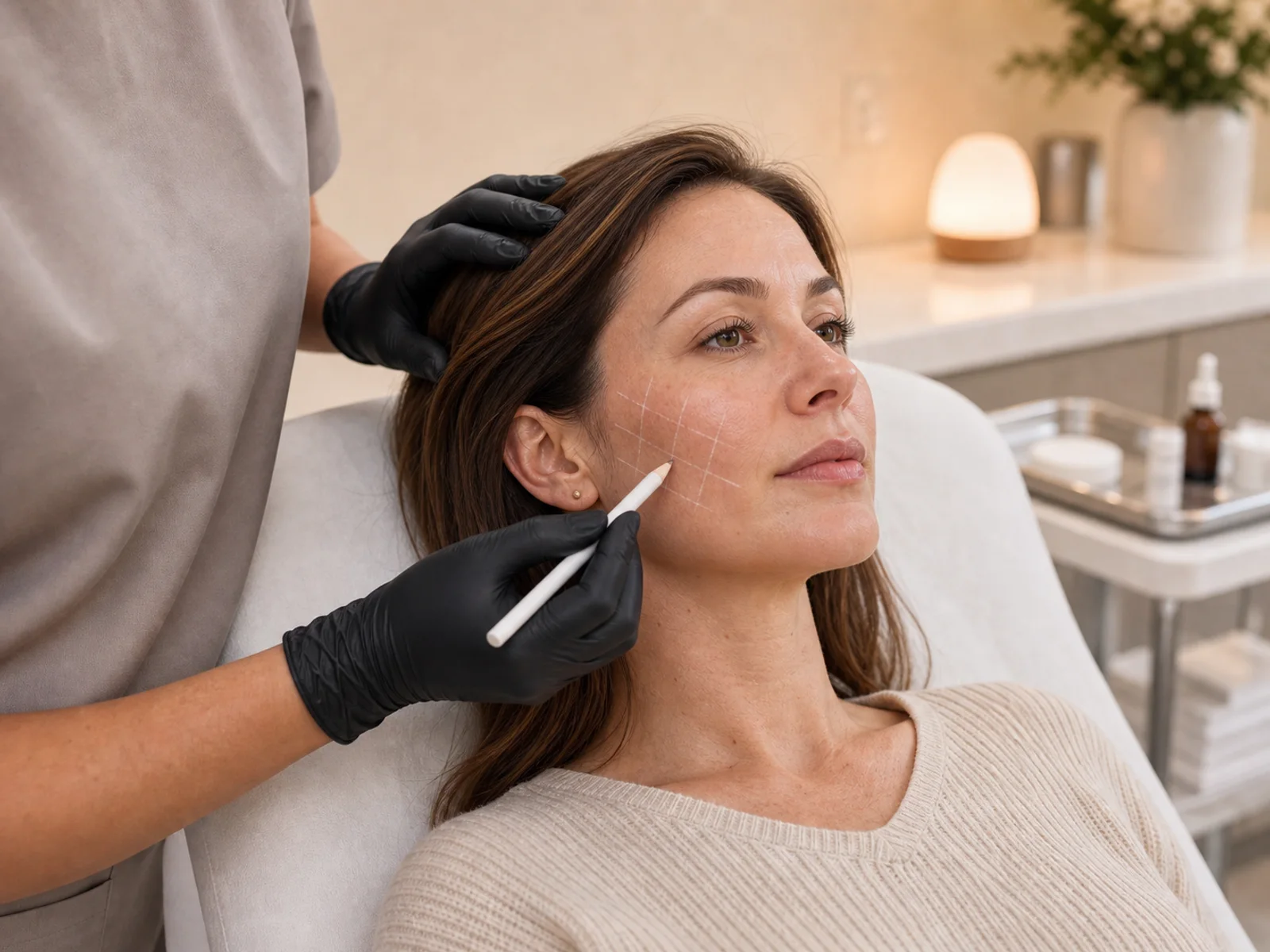
Treatment day. Numbing cream on for 15 minutes. I clean and mark a small entry point. With a cannula, I deposit small amounts of filler at three or four anatomical landmarks per cheek. You feel pressure. Not pain. Whole appointment is around 45 minutes.
You see the result straight away. Some asymmetric swelling for the first 48 hours. That’s normal. The real picture is at the 2-week review.
The first 48 hours.
- Ice on and off for the first few hours
- No alcohol for 24 hours
- No strenuous exercise for 24 hours
- No saunas, steam rooms or sunbeds for 48 hours
- No facial massage, microneedling or other facial treatments for 14 days
- Sleep on your back the first night if possible
- Bruising at the cannula entry point is common. Arnica gel helps
- Light makeup is fine after 4-6 hours; avoid heavy pressure on the cheekbone
If anything feels wrong. Severe pain, white patches, vision changes. Message me on WhatsApp immediately.
What I tell everyone.
Common: bruising at the cannula entry point. Swelling for 24 to 72 hours. Mild tenderness. The odd palpable lump that settles as the filler integrates over 2 to 4 weeks.
Rare but real: vascular occlusion. More relevant in the cheek than most areas because the facial artery is close. This is exactly why I use a cannula for cheek work where possible. It’s safer. Dissolving enzyme is on site at all times.
NMC registered. Registered with the NMC.
Good to know.
Will it make my face wider?
Will it make my face look fuller?
How long does cheek filler last?
How many ml do I need?
Will it migrate?
Does it hurt?
Can I have it dissolved if I don’t like it?
What about cheek filler “migration” I see online?
Will it help with under-eye hollows?
Can I have it if I’m pregnant or breastfeeding?
Book your cheek filler.
Choose your option and pick a time — booked online in under a minute.
You might also explore.
From the journal.
“Natural-looking results”. What that actually means here →Across the North East.
Clients travel from across the North East for cheek filler at Refined. Pick your town below for the drive, parking and local questions.